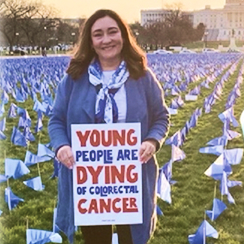
Sunni Lazo
Alpharetta
By the summer of 2021, I had experienced several months of discomfort, changes in bowel habits, and rectal bleeding. I had been to see my gynecologist for an annual visit, and she dismissed my symptoms. Later that summer, I visited my primary care physician, and she referred me to get a colonoscopy. When I woke up from the procedure, I was told I had rectal cancer. Every cancer patient knows the immediate feeling of shock and change when you receive a diagnosis. Your life is suddenly divided into “before-cancer” and “after-cancer.” I immediately launched into research, doctor’s visits, tests, and procedures.
After multiple surgeries, chemotherapy, radiation, an ostomy, and pelvic rehabilitation, I am overjoyed to say my recent scans continue to be clear. Side effects of treatment still linger, and to a certain degree, they always will. Cancer kept me away from my job as a teacher for 2 1/2 years and had a profound effect on my family’s finances. This past August, I went back to work as a teacher for an online school which allows me to be home every day near my bathroom.
I will always and forever credit my primary care physician for saving my life!
Kim Jette
Cumming
On Labor Day weekend of 2019, at the age of 47, I ended up in the ER because of severe pain in my abdomen and found I had Stage IV colon cancer. During that initial stay, I had a partial colectomy to remove the primary tumor in my sigmoid colon and entered into what would be an over five-year journey of treatments, surgeries, and complications. I had a liver resection where 90% of my liver was removed, had not one, but two diaphragmatic ruptures as a result of post-surgical complications, and a hysterectomy and oophorectomy as preventative measures.
In the family of Lynch Syndrome. Upon further testing, we discovered that my dad also has this genetic mutation and at the time, was a two-time cancer survivor (kidney and colon). His colorectal surgeon chose not to tell him about the mutation because his daughters were under the age of 50.
Colon cancer is NOT an old man’s disease. It is impacting patients at much younger ages and advanced stages. My hope is that no doctor ever makes that same mistake, and that people are aware of the symptoms of colorectal cancer and seek medical treatment. I don’t want my daughter, who could be a carrier of this same mutation, to be affected.
Immunotherapy treatment last December. I now enter the phase of heavy surveillance with frequent bloodwork and scans. I have plenty to celebrate; however, I have many friends and acquaintances in the colorectal cancer community that continue to face treatments and surgeries, some who have died at far too young an age, and all of us wanting more – more awareness, more research, more funding.
Robert Bone
Woodstock
My wife and I had both just lost our jobs because of COVID, so we did not have insurance. My wife got a job in October 2021, and we finally got insurance in November. We scheduled a colonoscopy, and we found a cancerous mass. After surgery to remove the mass, an oncologist told me it was my choice if I wanted to do chemo. He said the chemo would not make that much of a difference, so I opted out.
More surgery, I would have to use an ostomy bag for the rest of my life, and I didn’t want that. Proton therapy got rid of it, but then in August 2024 we found another mass, and last November, I again had surgery. While the doctor performed the surgery, she saw that it was invasive to my bladder, but she was able to get it all out.
I was 33 when I was diagnosed with colon cancer – almost 10 years younger than the recommended screening age. As a football coach, I was able to show up for the students in my community, as well as my family and the other loved ones in my life. We need you to show up for families like mine. Please support Georgia CORE’s mission to help educate Georgians on the signs and symptoms of colon cancer.
Laura Giglio
Marietta
After having my second child, I would on a rare occasion think I'd see something red in my stool, but it could easily be (and was often) passed of as a post-partum hemorrhoid, eating something unusually red, etc. It never seemed overly "alarming" and happened pretty infrequently, but in the back of my mind, I would always be reminded that my dad had colon cancer a few years back - could it be that? I asked my dad if he ever had symptoms like that - he didn't; I googled symptoms countless times - again nothing really seemed alarming because I didn't have any of the other symptoms. I asked doctors - more than once - and more than one different kind of doctor, and they always said the same things: I was young, I was healthy, it could just take a while for my body/GI to get back to normal after having a baby, and that even with my dad's history, the standard protocol would be to start 10 years before that (he was in his 60s) so the standard one at 45 would catch anything.
As time went on and it got further from the birth of my son (2 years later) and the symptoms would still show up occasionally, my gut was telling me something wasn't right. A friend whose family also has a history of colon issues nudged me, telling me she'd gotten a colonoscopy and was giving me my PSA that I should also get one. In March 2024, at the age of 37 and not 45, I finally went in for the procedure, and later woke up to the doctor saying, "Well, it's not what we would have wanted...we found a mass...we took a sample to send off to the lab...I'm referring you to a surgeon and an oncologist and you need to schedule a CT scan." That was our hardest day, but thankfully, we had friends, family, and prayer warriors who listened to us, cried with us, encouraged us, and gave us tangible things to work on and toward.
Lots of appointments, scans and tests later, we had an official diagnosis: Stage 3b Rectal Cancer. First and second opinions both recommended a new protocol, the PROSPECT trial protocol, based on my age and tumor location. I did six rounds of chemo, paired with a strict nutrition plan, and then re-scanned hoping for enough shrinkage to do surgery next and avoid radiation. Thankfully, I had almost a complete response to the chemo and nutritional changes. I had surgery in August of 2024 to remove the final cancerous cells, and I am so grateful that my scans and bloodwork have been clear since.
I will continue to have regular monitoring for the next few years, but have been able to mostly return to normal life. I am thankful that I trusted my gut (even if it took a couple years) and was diagnosed when I was. I am grateful for my care team and my community who tackled my diagnosis head on and kept my family and me grounded and optimistic. This is a disease that is showing up more and more in younger people. I would encourage anyone who has even the smallest concern to be bold and ask, advocate for yourself, ask for a colonoscopy – it could save your life!


 Stomach Pain
 unexplained weight loss
 changes in bowel habits
 blood in stool
 Funky/Skinny Poop
 Diarrhea
 Anemia
 Fatigue


